Trusted Concrete Pros in Denver
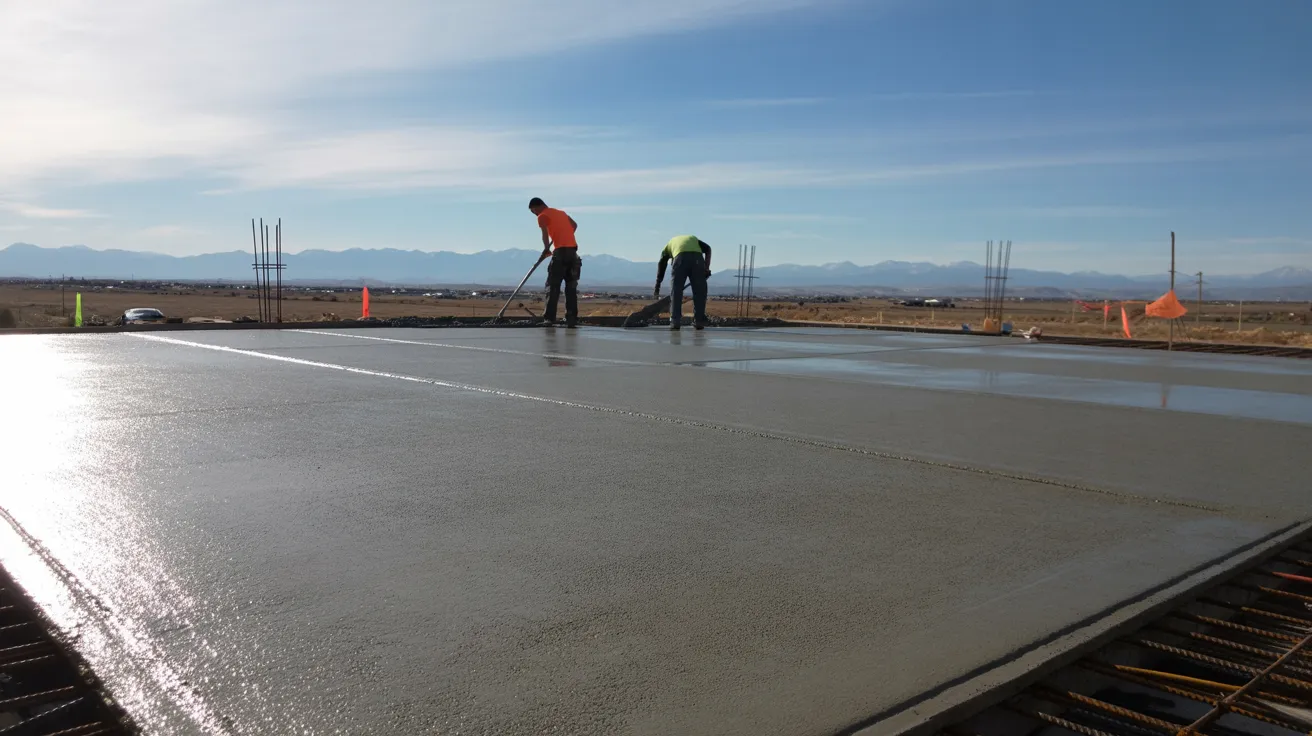
You'll need Denver concrete professionals who engineer for freeze–thaw, UV, and hail. We specify 4,500–5,000 psi, air‑entrained mixes (w/c ≤0.45), #4 rebar at 18-inch o.c., Class 6 bases compacted to 95% Proctor, and saw cuts within 6 to 12 hours. We oversee ROW permits, ACI, IBC, and ADA compliance, and schedule pours by wind, temperature, and maturity data. Look for silane/siloxane sealing for deicer protection, 2% drainage slopes, and stamped, stained, or exposed-aggregate finishes performed to spec. This is the way we deliver lasting results.
Essential Highlights
Why Regional Knowledge Is Important in Denver's Climate
Since Denver swings from freeze-thaw cycles to high-altitude UV and sudden hail, you need a contractor who engineers mixes, placements, and schedules for this microclimate. You're not just pouring concrete; you're addressing Microclimate Effects with data-driven specs. A experienced Denver pro chooses air-entrained, low w/c mixes, optimizes paste content, and times finishing to prevent scaling and plastic shrinkage. They assess subgrade temps, use maturity meters, and validate cure windows against wind and radiation.
You also require compatibility with Snowmelt Chemicals. Local expertise verifies deicer exposure classes, determines SCM blends to decrease permeability, and designates sealers with proper solids and recoat intervals. Control-joint spacing, base drainage, and dowel detailing are adjusted to elevation, aspect, and storm patterns, ensuring your slab operates consistently year-round.
Solutions That Improve Curb Appeal and Longevity
Though visual appeal shapes initial perceptions, you secure value by specifying services that strengthen both visual appeal and lifespan. You start with substrate conditioning: density testing, moisture testing, and soil stabilization to minimize differential settlement. Specify air-entrained, low w/cm concrete with fiber reinforcement, then add control-joint configurations aligned to geometry. Apply penetrating silane/siloxane sealer for protection against freeze-thaw cycles and deicing salts. Include edge restraints and proper drainage slopes to direct runoff away from slabs.
Enhance curb appeal with stamped concrete or exposed aggregate surfaces tied to landscaping integration. Employ integral color along with UV-stable sealers to avoid fading. Add heated snow-melt loops where icing occurs. Plan seasonal planting so root zones won't heave pavements; install geogrids and root barriers at planter interfaces. Complete with scheduled reseal, joint recaulking, and crack routing for lasting performance.
Working Through Construction Permits, Code Requirements, and Inspections
Before you pour a yard of concrete, navigate the regulatory requirements: validate zoning and right-of-way requirements, pull the proper permit class (e.g., ROW, driveway, structural slab, retaining wall), and align your plans with the Denver Building Code, IBC/ACI 318, ACI 301, and ADA/PROWAG where applicable. Establish the scope, compute loads, indicate joints, slopes, and drainage on stamped drawings. Present complete packets to minimize revisions and manage permit timelines.
Coordinate activities according to agency milestones. Dial 811, flag utilities, and book pre-construction meetings when necessary. Use inspection coordination to avoid idle crews: book formwork, subgrade, reinforcement, and pre-concrete inspections with buffers for rechecks. Record concrete delivery slips, density tests, and as-built drawings. Complete with final inspection, right-of-way restoration approval, and warranty enrollment to ensure compliance and handover.
Materials and Mix Solutions Built for Freeze–Thaw Endurance
Throughout Denver's swing seasons, you can specify concrete that withstands cyclic saturation and deep freezes by engineering air-void systems and paste quality, not just strength. You'll initiate with air entrainment directed toward the required spacing factor and specific surface; confirm in both fresh and hardened states. Design for low permeability using a lower w/cm (≤0.45), well-graded aggregates, and supplementary cementitious materials to refine pore structure. Execute freeze thaw testing per ASTM C666 and durability factor acceptance to validate performance under local exposure.
Select optimized admixtures—air stabilizers, shrinkage control agents, and set-controlling agents—that work with your cement and SCM blend. Fine-tune dosage by temperature and haul time. Specify finishing that retains entrained air at the surface. Initiate prompt curing, keep moisture, and eliminate early deicing salt exposure.
Driveways, Patios, and Foundations: Highlighted Project
You'll learn how we spec durable driveway solutions using correct base prep, joint layout, and sealer schedules that correspond to Denver's freeze–thaw cycles. For patios, you'll review design options—finishes, drainage gradients, and reinforcement grids—to harmonize aesthetics with performance. On foundations, you'll select reinforcement methods (steel schedules, fiber mixes, footing dimensions) that meet load paths and local code.
Sturdy Driveway Options
Develop curb appeal that lasts by specifying driveway, patio, and foundation systems built for Denver's freeze–thaw cycles, expansive soils, and de-icing salts. Avoid spalling and heave by selecting air-entrained concrete (6±1% air), mix of 4,500+ psi, and low w/c ratio ≤0.45. Specify No. 4 rebar at 18" o.c. each way or #3 at 12" with fiber mesh; place on 4–6" compressed Class 6 base over geotextile. Place control joints at maximum 10' panels, depth one-quarter slab depth, with sealed saw cuts.
Control runoff and icing by installing permeable pavers on an open-graded base and include drain tile daylighting. Explore heated driveways using hydronic PEX or electric mats, sized via ASHRAE snow-melt rates; insulate edges, install slab sensors, and integrate GFCI, dedicated circuits, and slab isolation from structures.
Outdoor Patio Design Options
While form should follow function in Denver's climate, your patio can still deliver texture, warmth, and performance. Start with a frost-aware base: six to eight inches of compacted Class 6 road base, 1 inch of screeded sand, and perimeter edge restraint. Choose sealed concrete or vibrant pavers rated for freeze-thaw; specify 5,000-psi mix with air entrainment for slabs, or polymeric sand joints for pavers to withstand heave and weeds.
Improve drainage with a 2% slope moving away from structures and well-placed channel drains at thresholds. Include radiant-ready conduit or sleeves for low-voltage lighting below modern pergolas, plus stub-outs for gas and irrigation. Utilize fiber reinforcement and control joints at 8–10 feet on center. Complete with UV-stable sealers and slip-resistant textures for year-round usability.
Reinforcement Methods for Foundations
After planning patios to handle freeze-thaw and drainage, the next step is strengthening what lies beneath: the load-bearing slab or footing through Denver's moisture-sensitive, expansive soils. You start with a geotech report, then specify footing depths beneath frost line and continuous rebar cages tied per ACI 318. Use #4 or #5 bars with 3-inch cover, doweled into grade beams. For slabs, specify a low-shrink, air-entrained mix with steel fiber reinforcement to minimize microcracking and distribute loads. Where soils heave, add drilled micropiles or helical piers to competent strata, isolating slabs with void forms. At stem walls, detail epoxy-set dowels and shear keys. Remediate cracked elements with epoxy injection and carbon wrap for confinement. Confirm compaction, vapor barrier placement, and proper curing.
The Contractor Selection Checklist
Before committing to any contract, nail down a clear, verifiable checklist that distinguishes real pros from risky bids. Begin with contractor licensing: check active Colorado and Denver credentials, bonding, and liability and worker's compensation insurance. Validate permit history against project type. Next, assess client reviews with a bias for recent, job-specific feedback; prioritize concrete scope matches, not generic praise. Normalize bid comparisons: request identical specs (reinforcement, mix design, PSI, subgrade prep, joints, curing technique), quantities, and exclusions so you can contrast line items cleanly. Require written warranty verification specifying coverage duration, workmanship, materials, heave and settlement thresholds, and transferability. Evaluate equipment readiness, crew size, and scheduling capacity for your window. Finally, insist on verifiable references and photo logs tied to addresses to demonstrate execution quality.
Open Cost Estimates, Project Timelines, and Correspondence
You'll require clear, itemized estimates that connect every cost to scope, materials, labor, and contingencies. You'll set realistic project timelines with milestones, critical paths, and buffer logic to eliminate schedule drift. You'll insist on proactive progress updates—think weekly status, blockers, and change logs—so decisions are made quickly and nothing falls through the cracks.
Clear, Comprehensive Estimates
Often the best first action is insisting on a clear, itemized estimate that maps scope to cost, timeline, and communication cadence. You require a line-by-line itemized breakdown: demo, excavation, base prep, rebar, mix design, placement, finishing, curing, sealing, cleanup, and disposal. List quantities (rebar LF, cubic yards), unit costs, crew hours, equipment, permits, and testing. Demand explicit inclusions/exclusions and a contingency line item with a capped percentage and release conditions.
Validate assumptions: site soil parameters, site access restrictions, debris hauling charges, and weather protections. Require vendor quotes submitted as appendices and require versioned revisions, akin to change logs in code. Mandate payment milestones tied to measurable deliverables and documented inspections. Require named roles and a communication protocol for RFIs, approvals, and variance notifications, with timestamps and response SLAs.
Practical Work Timeframes
Though cost and scope define the parameters, a realistic timeline stops overruns and rework. You deserve end-to-end timelines that correspond to tasks, dependencies, and risk buffers. We sequence excavation, formwork, reinforcement, placement, finishing, and cure windows with available resources and inspection lead times. Weather-based planning is essential in Denver: we coordinate pours with temperature ranges, wind forecasts, and freeze-thaw windows, then specify admixtures or tenting when conditions vary.
We incorporate slack for permitting contingencies, utility locates, and concrete plant load queues. Each milestone is timeboxed: demo complete, subgrade proof-rolled, forms set, steel tied, pour executed, initial set, saw cuts, cure achieved, and final closeout. Every milestone features entry/exit criteria. If a dependency slips, we re-baseline early, reallocate crews, and resequence independent work to maintain the critical path.
Timely Status Communications
Because transparent processes drive success, we publish clear estimates and a continuously updated timeline you can audit at any time. You'll see deliverables, budgets, and risk indicators tied to specific activities, so decisions stay data-driven. We push schedule transparency with a shared dashboard that follows project interdependencies, weather interruptions, regulatory inspections, and concrete setting times.
We'll provide you with proactive milestone summaries upon completion of each phase: demo, subgrade prep, forms, reinforcement, pour, finish, and seal. Every report shows percent complete, variance from plan, blockers, and next actions. We schedule communication: morning brief, daily wrap-up, and a weekly look-ahead with material ETAs.
Change requests trigger instant diff logs and revised critical path. When a constraint emerges, we present alternatives with impact deltas, then proceed upon your approval.
Best Practices for Reinforcement, Drainage, and Subgrade Preparation
Before you place a single yard of concrete, establish the fundamentals: reinforce strategically, handle water management, and construct a stable subgrade. Commence with profiling the site, clearing organics, and confirming soil compaction with a nuclear density gauge or plate load test. Where native soils are weak or expansive, install geotextile membranes over leveled subgrade, then add well-graded base and compact in lifts to 95% modified Proctor.
Use #4–#5 rebar or welded wire reinforcement based on span/load; secure intersections, keep 2-inch cover, and set bars on chairs, not in the mud. Manage cracking with saw-cut joints at 24–30 times slab thickness, cut within 6–12 hours. For drainage, set a 2% slope away from structures, add perimeter French drains, daylight outlets, and install vapor barriers only where necessary.
Aesthetic Surface Treatments: Stamped, Acid-Stained, and Revealed Aggregate
Once drainage, reinforcement, and subgrade secured, you can specify the finish system that meets performance and design targets. For stamped concrete, select mix slump 4–5 inches, use air-entrainment for freeze-thaw protection, and implement release agents corresponding to texture patterns. Schedule the stamp at initial set—no bleed water—then joint to ACI 302 spacing. For stains, create profile CSP two to three, verify moisture vapor emission rate below 3 lbs/1000 sf/24hr, and choose reactive or water‑based systems according to porosity. Complete mockups to validate color techniques under Denver UV and altitude. For exposed aggregate, seed or broadcast aggregate, then use a retarder and controlled wash to an even reveal. Sealers must be compatible, VOC-compliant, and slip-resistant with deicers.
Maintenance Plans to Preserve Your Investment
From the outset, treat maintenance as a spec-driven program, not an afterthought. Establish a schedule, assign responsible parties, and document each action. Capture baseline photos, compressive strength data (where accessible), and mix details. Then perform seasonal inspections: spring for thermal cycling effects, summer for UV degradation and joint displacement, fall for sealing gaps, winter for deicer impact. Log discoveries in a documented checklist.
Seal all joints and surfaces following manufacturer-specified intervals; ensure proper cure duration before traffic exposure. Maintain cleanliness using pH-suitable products; steer clear of chloride-concentrated deicing materials. Measure crack width progression with gauges; take action when limits exceed specifications. Perform yearly slope and drain calibration to avoid water accumulation.
Employ warranty tracking to align repairs with coverage timeframes. Keep invoices, batch tickets, and sealant SKUs. Monitor, refine, cycle—safeguard your concrete's longevity.
Questions & Answers
How Do You Manage Surprise Soil Challenges Found During the Project?
You perform a quick assessment, then execute a repair plan. First, reveal and document the affected zone, perform compaction testing, and document moisture content. Next, apply soil stabilization (cement-lime) or remove and rebuild, implement drainage correction (French drain systems and swales), and complete root removal where intrusion exists. Authenticate with density testing and plate-load analysis, then re-establish elevations. You adjust schedules, document changes, and proceed only after QC sign-off and specification compliance.
What Warranties Cover Workmanship Versus Material Defects?
Much like a protective net below a high wire, you get two protective measures: A Workmanship Warranty protects against installation errors—poor mix, placement, finishing, curing, control-joint spacing. It's contractor-guaranteed, time-bound (often 1–2 years), and corrects defects caused by labor. Material Defects are manufacturer-backed—cement, rebar, admixtures, sealers—protecting against failures in product specs. You'll file claims with documentation: batch tickets, photos, timestamps. Check exclusions: freeze-thaw, misuse, subgrade movement. Match warranties in your contract, much like integrating robust unit tests.
Are You Able to Provide Accessibility Features Including Ramps and Textured Surfaces?
Yes—we do this. You define widths, slopes, and landing areas; we construct ADA ramps to satisfy ADA/IBC standards (maximum 1:12 slope, 36"+ clear width, 60" landing areas and turns). We include handrails, curb edges, and drainage. For navigation, we incorporate tactile paving (dome-pattern tactile indicators) at crossings and transitions, compliant with ASTM/ADA specs. We model expansion joints, grades, and finish textures, then pour, complete, and verify slip resistance. You'll receive as-builts and inspection-prepared documentation.
How Do You Schedule Around Neighborhood Quiet Hours and HOA Rules?
You schedule work windows to align with HOA coordination and neighborhood quiet time constraints. To start, you review the CC&Rs like specifications, extract noise, access, and staging regulations, then construct a Gantt schedule that flags restricted hours. You present permits, notifications, and a site logistics plan for approval. Crews arrive off-peak, use low-decibel equipment during sensitive hours, and shift high-noise tasks to allowed slots. You log compliance and notify stakeholders in real time.
What Financing or Phased Construction Options Are Available?
"The old adage 'measure twice, cut once' applies here." You can choose read more Payment plans with milestones: deposit payment, formwork completion, Phased pours, and finishing touches, each invoiced net-15/30. We'll scope features into sprints—demo, base prep, reinforcement, then Phased pours—to synchronize your cash flow with inspections. You can mix 0% same-as-cash offers, automated ACH payments, or low-APR financing. We'll organize the schedule like code releases, lock dependencies (permits, mix designs), and avoid scope creep with change-order checkpoints.
Final Thoughts
You've seen why regional experience, code-compliant execution, and temperature-resilient formulas matter—now it's time to act. Pick a Denver contractor who structures your project right: properly reinforced, drainage-optimized, foundation-secure, and regulation-approved. From residential flatwork, from exposed aggregate to stamped patterns, you'll get honest quotes, defined timeframes, and regular communication. Because concrete isn't guesswork—it's engineering. Protect your investment with regular upkeep, and your visual impact remains strong. Ready to pour confidence? Let's convert your vision into a concrete reality.